T2-61 : FILM OPENING PROJECT 2008/9
Thursday, 5 March 2009
Production Meeting
This lesson we have been adding the finishing touches to our opening sequence. Rob has been making the soundtrack for the sequence using garage band. Whilst Jon has diligently been editing the sequence, adding titles and making sure that the sequence is in the right order. Myself and Jordan have been editing the freeze frame titles, inserting silhouettes of the characters in front of a comic style background using Photoshop.
By the end of this lesson we hope to have achieved a finished opening seqences, edited, with a soundtrack and hopefully if achieved with a narration. The narration will hopefully explain the story line and will be achieved by Jordon doing a voice over.
Monday, 2 March 2009
Thursday, 26 February 2009
Thursday Work
We did a lot of editing work today. Jon has been relentlessly been using gamma, brightness and contrast to make the editing look more authentic. We managed to get a clip from part of our film and successfully put our editing to it. You'll see the editing work on the rough cut on monday.
Jordan came in at 9am, yesterday she was not in. Though, this was not intentional as she has had drama trips. Lottie has come in today and given us some good advice and help on the editing.
Rob has been doing the music and has done 72 seconds so far (1:12). Might need to make it longer which should be hard. =/
We have been looking up different types of fonts from www.dafont.com they have great fonts there and we might be using 'Comic Book' as the font.
Wednesday, 25 February 2009
Wednesday 18th February
On Wednesday we stated to film some of our opening sequence. We decided to film the last section of the opening sequence which is the indoor scenes before we filmed the alleyway scenes. The only section that we had to change was the scene when we introduced Antonio Accardo. This was because the actor who we were going to film couldn't make it to the filming on wednesday so we adapted this to be able to film it at on Friday 20th February.
Locations
For our Locations we chose to film the most in Christ Peace. This was because we found an Alleyway which doesn't have a time period associated with it but also it allowed us to not give it away that we weren't in the 1930's because there were no cars or modern shops in the area that we filmed.
Here are some images that we took when we went to have a look various locations across cambridge on Thursday 12th February.
Thursday, 12 February 2009
This is the script so far:
The Filmores
The Filmores
OPENING SEQUENCE
Starting out in a dark, narrow and dreary alleyway. The setting is of 1930s style architecture showing little light, a few windows and a few bins. A cold wind shivers through the air as the temperatures drop in what is supposed to be some of the worst economic and financial times the United States has ever had to face.
{ENTER Don}
Don is found running fast past the camera showing half of his face to the audience whilst facing towards the end of the alleyway being chased. He is holding in his left hand a briefcase.
[Don breaths heavily]
{ENTER Mafiaman}
Running after Don because Don has stolen his brief case off him. Wearing a clean cut suit showing off that he means business in these desperate times.
~ Rob
Starting out in a dark, narrow and dreary alleyway. The setting is of 1930s style architecture showing little light, a few windows and a few bins. A cold wind shivers through the air as the temperatures drop in what is supposed to be some of the worst economic and financial times the United States has ever had to face.
{ENTER Don}
Don is found running fast past the camera showing half of his face to the audience whilst facing towards the end of the alleyway being chased. He is holding in his left hand a briefcase.
[Don breaths heavily]
{ENTER Mafiaman}
Running after Don because Don has stolen his brief case off him. Wearing a clean cut suit showing off that he means business in these desperate times.
~ Rob
Wednesday, 11 February 2009
Prop-list and costume list
Location ideas
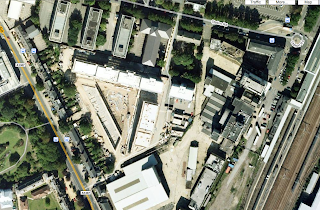
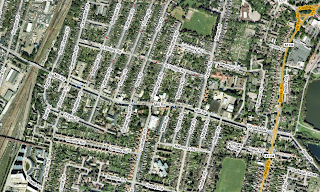
We have been looking at various locations that will may use to film. All of the photos are from Google Maps in satellite mode. All of our locations are in cambridge because it is easy to organise transport.
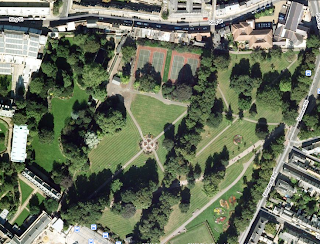
Christs Piece

Mill Road

Apartment Buildings near the Train Station
Tuesday, 3 February 2009
Analysis of Point Break
The title sequence of Point Break is very similar to Oceans 11 in the way that it uses the micro-elements to refernce teh narrative. The sequence starts off with a coastal scene showing a mid shot to close up of the waves crashing on the beach. The camera stays stays still during this scene which allws the audience to read the titles without getting distracted. The title of the film appears embossed over the scene just showing the outline of the text like it has been stamped over the sequence. The mise-en-scene shows one of the main settings that is referenced to in the main narrative as well as setting an atmosphere of a nice, calm evening on a beach with a golden sun colour filling the scene. Everything would make the audience feel relaxed and calm except for an uneasy drone thoughout the whole title sequyence.
The next scene we see a close up of a surfer heading out to see. This is important because it is a key part of the narrative. All of teis scene we see vrious shots of the surfer, surfing on huge swells. All of these shots are slowed down which combined with the drone make an extremly uneasy atmosphere for the audience to watch. The colour of this scene makes the water seem very cold as it is a deep blue , almost grey colour. But throughout the scene we don't get to see the surfers face. This references to teh fact that the surfers are going to have criminal roles in the film.
The scene then cuts to a mid shot of Special Agent John Utah (Keanu Reeves) who is sitting on a car in the poring rain waiting for something. We then hear a whistle as a FBI agent calls Utah to come over. At this point the audience are unsure what he has to do but they understand that he probably won't be a villain because they see his face which allows them to identify with him. The editing then speeds up as Utah begins his training and cuts between various angles of Utah and many clips of the surfer. The mise-en-scene is very similar on both stories because we see a blue tint to them connoting cold tempretures. The training that Utah is doing and the surfers references key elements of the narrative with regards to the FBI, surfers and a gun fight. The camerawork shows mainly mid shots which show the action as well as the facial expressions of Utah.
This allows the audience to get a reflected atmosphere of what the film is going to be like as well as showing various aspects that are key to the narrative.
Labels: Jon
Sunday, 1 February 2009
Analysis of Oceans 11
The title sequence of Oceans 11 is very short and uses subtle effects, but it is extremely effective. It shows Daniel Ocean(George Clooney) moving towards a chair that is facing the camera. Through this first part of the sequence we see a midshot of ocean. We also hear a voice from 3 other people out of view from the camera. We find out that this is a hearing to see whether or not to release him from prison. This particular scene has many references to the narrative. This is due to the many micro-element features that have been used. The mise-en-scene plays a big part in referencing the narrative. The setting is a prison and because of the genre being a crime caper it shows that this is where the characters could end up, should they get caught. This references the atmosphere of the narrative because throughout the narrative there is always the rick of getting caught. This also comes through the use of costume, lighting, props and colour. The costume worn by Ocean is stereotypical prison wear consisting of beige overalls. The lighting is low key and the colour of the sequence has a blue tint to it. This shows that it is in a prison which is very secure due to very small windows making the low key lighting and grey concrete reflecting back a blue tint due to the lack of light. The props in this scene only consist of a chair. This shows that prison life is very uncomfortable because they don't look after the needs of the prisoners.
The sound of this scene is also important because all you hear is diegetic sound of the panel and Ocean speaking as well as a continuous drone of the ventilation system. With regards to the characters speaking you get echoes every time that they speak showing that they are in a very large and open space. There is no editing effects in this beginning sequence except for a fade at the beginning. And the camera stays still showing a focus on the character.
At the end of this scene Ocean is asked 'What will you do if released?'. The scene then jump cuts closer to ocean who looks smug showing that he already has another plan. A non-diegetic sound track begins to play. This lets the audience know that he has managed to get out of prison.
The next two scenes follow Ocean getting ready to leave the prison. All of teh camera placements are as if the audience are looking over ocean like a security guard or official. This is because the camera looks through bars, chicken wire fencing as well as panning long shots as he approaches a desk. The scene then cuts to a close up of a ring which relates to a narrative because we find out that his wife left him.
The next scene follows ocean out of prison. This is the first time the role of editing comes into play because this is the first time that we get to see the titles. These fly in from different directions.
And the final scene shows the main title of 'Oceans 11' in the bottom right corner. This scene shows a river or bay on the outskirts of a large American city during the evening.
Labels: Jon
Thursday, 29 January 2009
Thursdays lesson.
Today our animatic deadline is due. Myself and Jon have been taking photos of our storyboard using the mac camera and now we are working on our animatic using final cut.
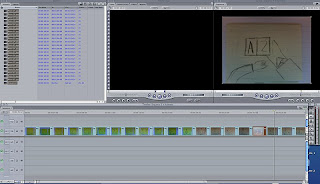
Soon we will be using garageband so we have a soundtrack for our animatic.
The animatic has to be about a minute long while our final opening sequence has to be two mintues.
Editing our Animatic
Wednesday's lesson.
On Wednesdays lesson we worked on our storyboards so we could start on our animatic which is due today (Thursday). We also did some research based on the feedback we got. We researched the 1920s and 1930s which our sequence is set in that time.
Jon worked on our storyboard while myself and Rob did some 1930s comic book research.
Sunday, 18 January 2009
Opening Sequence Analysis of the Italian Job
For my opening sequence I analysed the title sequence of the Italian Job (2003 version).
http://tvshack.net/movies/The_Italian_Job__2003_/
Some details about the film:
The film was directed by - F. Gary Gray
Ensemble Cast of - Mark Wahlberg, Charlize Theron, Edward Norton, Seth Green, Jason Statha, Mos Def, Franky Go and Donald Sutherland.
Brief Narrative Description: This film is about an organised crime gang who plan and implement stealing millions of dollars worth of gold from the Italian mafia. The start of the film focuses mainly on this. Then a scene in the
Description fo title sequence: This title sequence relies heavily on editing and camerawork to produce certain effects. The sequence starts off with a small horizontal gold line across the screen. This expands to fill half of the screen with an extreme long shot of
Analysis of title sequence: This sequence gives many references to the beginning of the narrative. The map that we see throughout the sequence seems to have various stickers and string added to it. At a glance the audience can't quite understand what the stickers say but they can focus on the times. This reveals to the audience that a crime is being very precisely planned. But although the title sequence seems to give away the whole narratve, it actually gives away a very small part of it, because this sub-narrative leads onto a much bigger and complex plot.
The camerawork in this scene is very clever in the way that it uses many different shots. During the title sequence we see midshots of travelling down the rivers of
The editing of this scene really helps to add subtleties to the camerawork. It does this by using small windows, horizontal bars and vertical bars. This makes the text less readable on the map but still allow the times to be clearly shown. The bars are also used as masks to only show the actual footage through the bar, almost like the audience are looking through a whole in the wall at the map. The pace of the editing changes depending on the speed of the percussional sound track. This combined with the panning and swirling of the shots of the map make it seem like the audience ar getting a sneak peak of the plan that its going into action. The titles themselves are positioned in normally dead areas of the scene or next to the bars/windows in the scene. This means that they aren't quite as noticeable as if they were covering the footage, which adds to the sense that not everything is going to be as it meets the eye.
While on the boat there is a relaxed atmosphere because the music is slower and quieter than on other parts of the scene. But there is also an anxious atmosphere due to the fact that the boat is moving along the rivers of
The staging of Mark Wahlberg is also very clever because the scene mainly has him in silhouette form making it harder for the user to identify it is him to start with. This makes us think he is a criminal by the way that he tries to keep himself disguised. But when he emerges from the gloomy shadows of the room by moving over to look at the final part of the map which is in a lighter area. We see a pleased look on his face as he looks at what he has accomplished. This then makes the audience identify with him more.
The percussional piece of sound that overlays the whole scene plays an important role. While the camera is showing the boat ride, the music has a more sinister and slower atmosphere to it, which tells the audience that something is going to happen and the characters are taking a risk because the camera is from the point of view of one of the characters. Then while we see Mark Wahlberg and the map the music speeds up creating a more tense atmosphere with elements that the character is trying to get this done quickly but also make sure that he hasn't missed anything.
So in conclusion, this sequence uses three micro elements of sound, editing and camerawork to portray hints and clues of the narrative.
----------------------------------------------------------------------
Jon
Labels: Jon